
Brown County Civil Docket Searches
Minnesota Court Records Online, called MCRO is the statewide search. It covers Brown County civil cases. Its Case Search opens a Case Details page, the Register of Actions for the file. Got the full court file number? Start there. If not, search by Person or Business name. Pick Brown from the county list and choose Civil as the category. Add a filing-date range only when similar results blur together. Every Brown County result still sits inside the statewide court system.
Case-number searches need the complete number. Dashes and leading zeroes can be dropped; spaces trigger an error. A Brown County name search matches exactly rather than by keyword. Try a person search with and without a middle name or initial. A trailing asterisk after two characters works as a wildcard. Sounds Like is its own alternative, not an added filter. A Brown County query can return up to 200 matches, listed newest first by default.
- Accept MCRO's terms and select Case Number or Name as the Brown County civil search route.
- Enter the complete number when available, or use the Brown County party name and select the Person or Business option.
- Limit the search to Brown County and Civil if the statewide list is too broad.
- Open Brown County Case Details and read the Register of Actions, hearings, dispositions, and documents together.
- Use a Brown County courthouse terminal or Brown County Court Administration if a public civil record is not visible remotely.
Search Brown Civil Cases in MCRO
MCRO lets a Brown County civil searcher narrow results without any separate county account. The Case Search page offers name, case number, citation number, and attorney modes. For civil matters, Name and Case Number do the work. A case number wins when you have one. A name search narrows by Date Filed, Case Category, Case Status, and Court Locations. Choosing Brown screens out statewide matches with no tie to the county.
Three other tools sit beside it. A Brown County Document Search needs a full case number. A Hearing Search gives date and setting details. A Judgment Search covers docketed monetary judgments. They are separate tabs, not layers of one search. A found case does not prove every public document is online. The Judgment Search skips nonmonetary outcomes. Pick the tab that matches what you need.
| MCRO field | Use for Brown County civil search | Format note |
|---|---|---|
| Name | Person or Business party search | Exact spelling; wildcard or Sounds Like alternatives |
| Case Number | Known Brown County court file | Complete number; no spaces |
| Date Filed | Limit a broad name search | Exact date or range |
| Case Category | Focus on Civil | Optional filter |
| Court Locations | Limit results to Brown County | Statewide or county-specific choice |
Civil Dockets: What They Show
A Brown County civil Register of Actions names the court file. It tracks the case's path. The Case Information entry can list the number, title or style, civil case type, filing date, Brown County venue, judicial officer, current status, and related cases. Party Information sorts roles like plaintiff, petitioner, defendant, respondent, or intervenor. It may name the attorney of record. Case Events gather the filings, service activity, answers, motions, notices, orders, and document index numbers.
Hearings keep both upcoming and past scheduling data. Dispositions carry terms such as dismissal, settlement, or judgment. Family cases may show dissolution, support, or custody labels instead. A closed status alone never reveals which outcome occurred. For a money judgment, the separate Judgment Search lists the judgment debtor. It also lists any later satisfaction data. Read the court-generated record and any order before assuming a result from one brief label.
| Case Information | File number, title, civil type, filed date, Brown County venue, judicial officer, status, and related cases. |
|---|---|
| Parties | Party roles and attorneys of record where publicly available. |
| Case Events | Complaint or petition, service, answers, motions, notices, orders, and document index numbers. |
| Hearings | Scheduled date, time, and type, plus prior hearing history when visible. |
| Disposition or Judgment | Dismissal, settlement, judgment, or a family-related outcome, with satisfaction information for monetary judgments. |
Brown Civil Case Labels
Brown County District Court is the civil venue named in the official Brown County court sources. MCRO splits Brown County civil matters into Major Civil, Minor Civil, and Conciliation categories. The listed civil types include contract, tort, consumer credit, property, personal injury, condemnation, forfeiture, conciliation, implied-consent, minor-civil judgment, and unlawful-detainer cases. Family stands apart as its own MCRO category, even though people often call it civil.
The courts post no local civil dollar threshold and no separate city civil court. Don't infer one from a category label. One Brown County District Court record system holds the civil case whether the event began with a local party, agency, or city office.
- Major Civil
- An MCRO civil category used for the broader district-court civil docket.
- Minor Civil
- An MCRO category that can include smaller civil matters and related civil judgments.
- Conciliation
- The Minnesota court category used for conciliation matters; the Brown-specific source did not state a current dollar threshold.
What Cases Fill the Civil Docket
A single Brown County civil docket can mix different paths and document sets. A contract, tort, property, or conciliation matter may open with a complaint or claim, then show service, an answer, motions, notices, hearings, and a disposition. A family case leans on petition and response wording. The category and its entries, not the city where an event started, tell you which Brown County court file you are reading.
For broader context, the Minnesota Judicial Branch publishes district court filing materials on the types of cases moving through the district-court system.
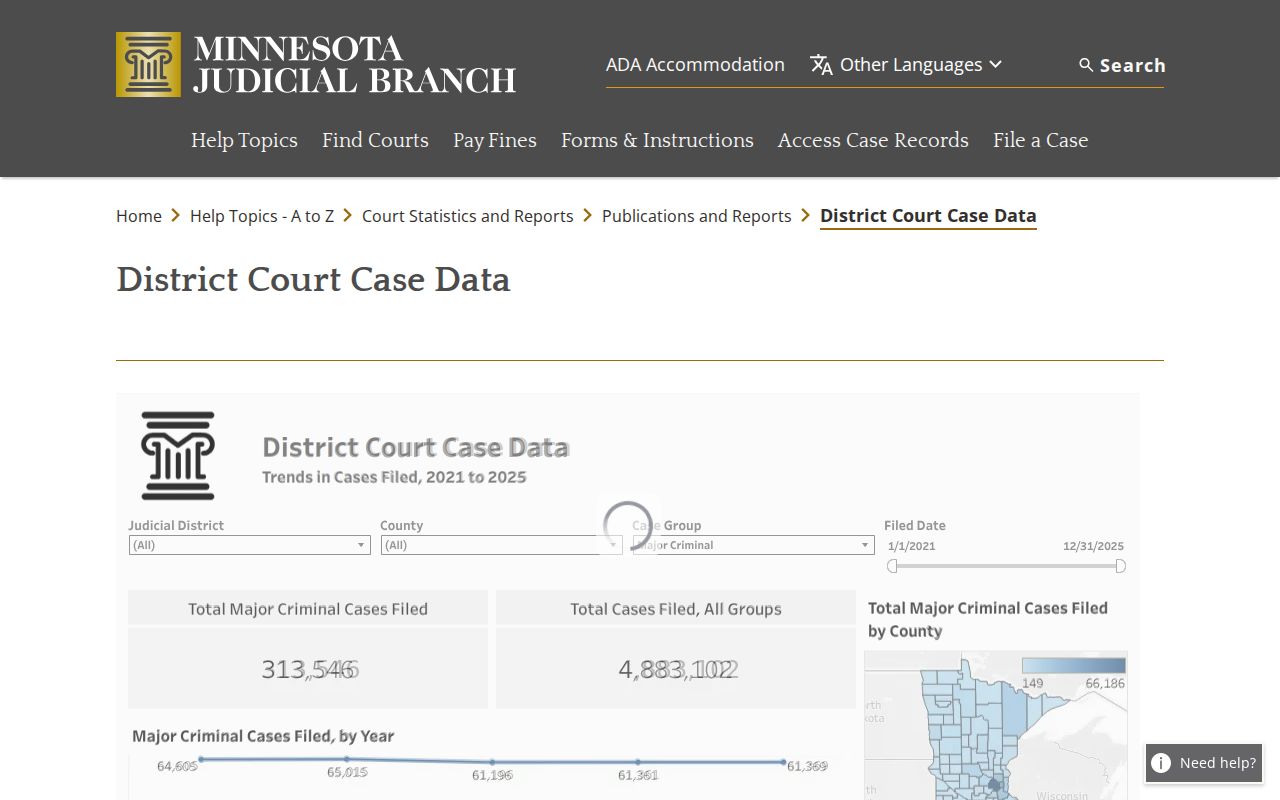
For one Brown County civil case, trust the Register of Actions and its case category as the public record. A filing publication offers only wider court-system context.
- Major civil matters, including contract, tort, property, condemnation, and personal-injury examples.
- Minor civil matters and eligible minor-civil judgment records.
- Conciliation cases assigned to the district-court system.
- Unlawful-detainer case types shown in MCRO's accessible examples.
- Family cases, with their own category and more limited remote document access.
Brown Civil Events Run Newest First
MCRO lists Brown County Case Events newest first. That ordering puts the latest order or notice on top. It can also bury the steps that produced it. Check the current status first. Then check the next scheduled hearing, and read the entries from the bottom up. Trace the civil docket through filing, service or citation, answer, discovery, motions, notice, trial, settlement, dismissal, or judgment. The Register of Actions is a full activity history, not a short case summary.
A Document Index Number may signal a linked record image. Plenty of numbers do not. When the View Document control appears, click it. The Brown County document name, date, and related event tell you more than any assumption drawn from a status field. A public document can be missing from the remote view. The courthouse terminal and a copy request through Brown County Court Administration are the next documented channels.
Hearings on the Civil Docket
Compare three things. Check the hearing entry in Brown County Case Details, the MCRO Hearing Search, and the Brown Weekly Public Court Calendar. Hearing Search takes a name, case number, judicial officer, or attorney. Add a hearing date, the Civil category, and the Brown County court location. The weekly calendar is a searchable PDF posted each business day and updated hourly. The printed courthouse calendar is still the most current version.
A Brown County setting can change. So can the judicial officer or the courtroom. Brown County's Fifth Judicial District practice strongly disfavors continuances, especially trial dates. Moving one normally takes a written request stating good cause. An old calendar line does not prove a cancellation. A missing online entry does not either. Read the newest Brown County Case Event. Then check the current calendar and call Brown County Court Administration when a conflict remains. The notice of hearing remains the primary notice to a party, even when a public docket entry later changes.
Brown Civil Judgment Searches
A monetary judgment calls for a focused search, not a full sweep of the Brown County civil docket. MCRO's Judgment Search starts with a judgment debtor name. The rules demand an exact name or an approved alternate-name method, plus a docketed-date range, judgment status, and statewide or Brown County court locations. Results are docketed monetary judgments and later satisfactions. Case Details holds other Brown County civil outcomes too.
Read the original Brown County civil Register first. Turn to Judgment Search only when a monetary judgment is the actual question. A satisfaction shows the judgment was collected or otherwise satisfied. The current amount can still shift with interest. Need a signed order or a certified judgment document? Use View Document if it appears, or go through Brown County Court Administration's copy route. Brown County's fee table lists a $40 transcript-of-judgment service separately, so request the precise record you need.
| Record | Where it appears | What it answers |
|---|---|---|
| Register of Actions | MCRO Case Details | Full public case activity, hearings, and stated disposition. |
| Judgment detail | MCRO Judgment Search | Docketed monetary judgment and satisfaction information. |
| Certified document | Brown County Court Administration | Official court-produced copy when a certified record is required. |
Who Can See Civil Dockets
Minnesota court rules control remote access to Brown County civil dockets. There is no separate county database policy. Rule 8 covers registers, calendars, indexes, judgment dockets, and certain court-prepared documents. These stay remotely accessible, subject to restrictions. Public Brown County civil documents in eligible categories filed on or after July 1, 2015 are generally available through MCRO. One caveat applies. The search output and any MCRO download are unofficial. The portal cannot certify them.
The broader public record goes beyond the remote view. Visit the Brown County courthouse public-access terminal or the paper-file counter. Brown County Court Administration handles the local court record, copies, and questions about older files. An uncertified court copy is free on the Brown County fee table. A certified instrument runs $14. A certified-and-exemplified copy runs $28. Confirm the exact current service before sending payment or a form.
Key Rules:
Minnesota Rule of Public Access 8 describes public inspection, copying, registers, calendars, and the different reach of remote access.
Minnesota Rule of Public Access 4 identifies several court records that are nonpublic or protected.
Minnesota Rule of General Practice 11 requires restricted identifiers to be protected from public filing access.
Brown Civil Family Documents
A Brown County family case can look public. Some of its documents stay offline anyway. MCRO may provide Brown County public court-generated orders, judgments, opinions, and notices in eligible family cases. Party-submitted motions, affidavits, and financial documents are another matter. MCRO does not serve those remotely. That split reflects a document-access rule. It is not proof the case has no public Brown County register.
Access narrows further for domestic-abuse, harassment, juvenile, adoption, civil-commitment, and other protected categories. A restriction may appear as an omitted document, no result, or a name not available online. Missing a public document? Try the Brown County courthouse terminal. Or ask Brown County Court Administration about the proper local record route. Confidential or sealed material may require the statewide access-request packet and a court order.
Brown Court Administration
Brown County Courthouse, 14 S State Street, third floor, New Ulm, MN 56073. Mail copy requests to P.O. Box 248, New Ulm, MN 56073.
507-441-7020
Note: Brown's official materials state no fixed processing time for copy or access requests.